Welcome to WordPress [Goodbye, Typepad]! This is my “first” post. Prove that you’re reading this by landing here.
Riot and Frolic
a mostly ballroom dance, but also a bunch of other stuff, blog
-
Okay, so you read The Dance Business and you're in. But there's no studios in your area (or maybe none that fit your vibe). What could you charge for a lesson? Who would come and take lessons? How would they find you? Why would they choose you over someone else?
Let's say you can charge $100/lesson. Just for context, I live in a fair-sized city in the Midwest and people with 40+ years of teaching experience, have a lauded professional career, and have all their judging credentials charge $100/lesson. But let's not take your résumé, location, or demand into account for a minute [cough cough].
PLEASE DON'T CHECK MY MATH ON THIS. IT GETS SUPER SKETCHY.
Self-employement taxes average 15%. Not to mention federal and state taxes, which run about 15% and 8% respectively. So you're making $62. WOW! That's amazing! At a studio, you wouldn't be making even close to that.
Floor fees, IF you can find somewhere to teach that works for you and your students, run $15-$30/lesson. You are now at a generous $47/hour.
Insurance (liability, property damage, bodily injury) runs about $67/month on average.
Website runs $12/month.
OH! And credit card processing fees, because very few people want to use cash or check these days, and want all the options for payments (credit cards, Venmo, Apply Pay, Zelle, PayPal, Google Pay, other things I don't even know exist, etc.).
And that's the things you HAVE to have to exist in the business today.
If you're teaching 20 hours a week, you're still at $44/hours, which is awesome. [But are you teaching 20 hours a week and charging $100 and getting floor fees for $15? Just note that if you charge $90 and work 10 hours in a week with floor fees at $20, you're at $32 at best.]
But then there's intangibles like:
- finding continued training
- scheduling continued training
- continued training might not be at the place you're teaching
- please tell me you're planning on training
- paying for practice space
- travel time, especially if you teach at more than one location
- filing business and personal taxes
- developing a strong sense of place in the industry (what's your niche/specialty? why do people come see YOU?)
- maintaining place in industry
Not to mention the time! OH THE TIME:
- time/money spent creating website (many/much)
- time spent creating socials (relatively easy)
- time/money spent updating website to keep that SEO popping (1 hour/month)
- time spent updating socials (1-2 hours/week)
- time spent organizing student scheduling (1-2 hours/week)
- time spent registering for competitions (1-2 hours/competition)
- time spent marketing and advertising for new students (1-2 hours/month)
- time spent bookkeeping (1-2 hours/week)
Which means, you're teaching 20 hours a week, but probably working 5 more "for free", at best. (That works out to well below $40/hour, btw.) But maybe you're closer to 10 hours/week and then you're making closer to $20 if you're looking at your hourly take-home pay. And that's assuming you have the clientele (or hustle and wherewithal) to get 10 private lesson hours a week.
Also, your students aren't getting the studio experience : there's not an automatic community of people gathering, there's not group classes, there's not social dances. There's very little crossover time from student to student, so interaction between students is few and far between. To boil it down, people are paying for your information delivery (your expertise and your personality).
As covered in previous posts, studios tend to have a charge more per lesson. Studios also pay:
- rent, tax, and CAM on the space
- business, liability, and property insurance (these are all separate)
- electric, gas, and water
- toilet paper, paper towels, printer paper, paper paper paper, WHY IS THERE SO MUCH PAPER
- credit card fees on client payments
- music licenses
- payroll and associated taxes/benefits for teachers
- workers' comp insurance
- lawyers (random legal things happen all. the. time.)
- additional staff
- receptionist(s)
- cleaning services
- manager(s)
- business interruption insurance all being awesome and extra
- extrasssssszzzzzz
- "free group classes"
- staff at socials
- seasonal decor
- food and drink at events
When you're comparing studio pricing to independent pricing, students should take the pros and cons into account. But as a pro, you also need to take your realistic employment opportunities into account. Do you have the training, résumé, and expertise to make money teaching? How will you hustle (or Hustle) to bring in new students? Do you have connections that you can leverage to find yourself teaching jobs? What kind of benefits are you able to offer that other people or places don't?
Are you looking to be the best teacher out there? What kind of teacher? A winner of Top Teacher at USDC? The most lesson hours taught at your world-class studio? Have championship-winning students? Be a sought-after choreographer? Be one of the Ballroom Mafia, who shapes and shifts styles behind the scenes? One who has students of all ages and proficiencies? One who works with primarily college students? A teacher who has long-term adorable couples who just love dancing together?
All of these are awesome aims and all of them have very different paths to get there.
Do you want to dance professionally? Just to do it or because you want to win the world championship? Do you want to do one style or multiple styles? What kind of time/money can you commit to putting in? Are you injury/sickness-prone? How long can you make that commitment for?
If you are long-term planning (and you should be), how are you going to grow in the industry? If you're at a studio and would like to be an independent instructor, how will you exit that position?
Looking way ahead, do you want to have a job in the industry that you'd like to do besides teaching? DJ, video production, photography, MC, scrutineer, judge, coach, choreographer, studio owner, dressmaker, tailor, vendor, marketer, studio manager, the list keeps growing!
If you don't know the answers to these questions, that's okay! This is an insane list that I've thought of or been asked about for YEARS. But if you'd like to explore a career in ballroom dancing, I'd highly suggest thinking about your answers and finding some people to harass about how to you could find your path in this awesome industry.
-
Let's say you're interested in becoming a professional ballroom dancer. If you haven't read my long-standing and still totally true posts on the myths, the pros, the cons, and the expectations, please do so now. I'll wait…
But how does the ballroom dance industry work? Or how does one become part of the professional side of the ballroom industry? AKA, HOW DO I MAKE MONEY AT THIS THING THAT I LOVE?
If you haven't been here in the last 13 years, you might not know I started writing this blog because I would get these great questions about dancing that I wanted to answer, but literally needed an essay form and visual aids to explain. And about 15 minutes of your and my time, and nobody wants to use their lesson time for that, especially when I need to guide you on your latin motion journey.
This post is no exception! I've gotten asked from all angles and ages for YEARS, so here we go:
If you have an interest in immersing yourself in ballroom dancing and sharing it with all ages, levels, and abilities, a teaching job is where you start. Most of the work of teaching dance is figuring out how to communicate large and small motor skills to a variety of different people. (Like, SUCH a variety: 4 year olds to 90 year olds, people who could barely walk in the door, people who have had careers in dance, people who are getting married tomorrow, people who are having their 50th wedding anniversary, people who want to compete, most who don't, people who want to do only salsa/waltz/tango/viennese/wahtever they do on DWTS.) Many of the people who take lessons are average Joes and Janes who weren't aware that ballroom dancing existed in their area before their Google search last night for their upcoming wedding on Saturday. They are also unaware of where their hip flexors are and how to use them. Oh, and the POSTURE! For Heaven's sake, the posture! But I digress…
New pros usually need to start out in a studio, for training alone. Many studios offer free instructor training, through a bit of indentured servitude (it's a joke, but it's not), that will get you in on the ground floor. Even then, your desire to build your ballroom dance repertoire must be REAL and CONCRETE and you must be able to communicate that knowledge with words and actions, and your personality must be one people like to be around.
If a new pro has their basics down, GREAT, but training is always necessary to keep at least one step ahead of their students. Training is not just dancing either! It's how to teach, how to prevent/fix mistakes, how to referee (we are part counselors, as well), and how to build your students a pathway to success (while also figuring out how to craft your own success). And the training is ENDLESS: a huge and ever-evolving syllabus in four styles, lifts/dips/drops, wedding dance choreography, routines for a variety of events, nightclub dances, ETC.
Another reason to start at a studio is the opportunity to teach. Through longevity and/or reputation, studios have people coming in the door looking for dance lessons and those new people will get sorted out to all the teachers. A new pro then has the opportunity to make dancing fun and enjoyable for those people and gain clients for themselves and the studio by teaching group classes, introductory lessons, and gigs in and outside the studio. With a charming personality and clear, entertaining delivery of information, most teachers can then build a client base of students, usually by selling private lessons to new students who they've encountered.
If you've been an enthusiastic student of dance, especially as a competitive pro-am or amateur couple, your training is partially taken care of, but Do You Know Your Basics (in words, actions, and cave drawings), or the Other Part (the part opposite the one you usually dance) on Anything? PROVE IT.
Even if you are the BEST DANCER (meaning you are dancing in the top categories and are winning or finaling at all the prestigious competitions), it might not mean you are a good teacher. It might not mean you have a job teaching and training other dancers outside of your own dancing. SEE BELOW.
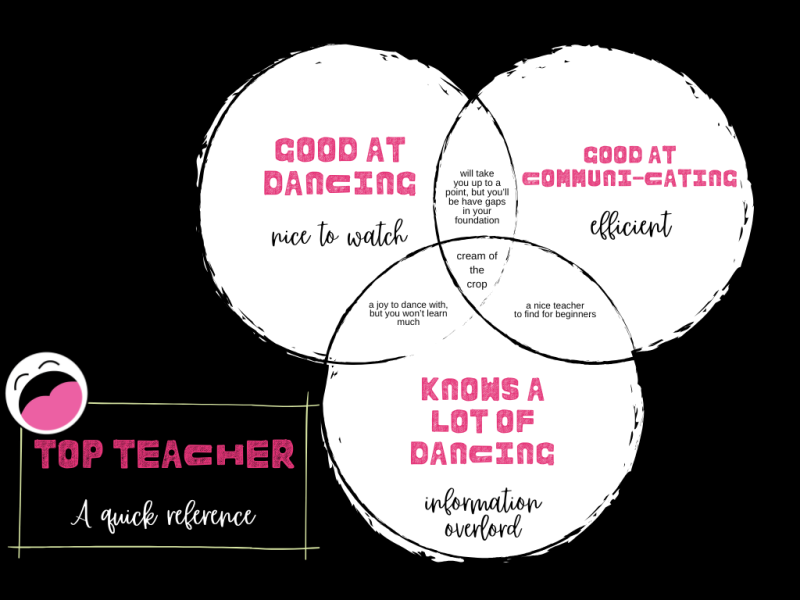
Any ballroom instructor who is making a living is very good at dancing, knows a great deal of information about dancing, and is very effective at communicating.
The rub: even with the best instruction in … instructing, teaching is still a mash-up of clear communication, reading a room/people/person, experience, efficiency, therapy, and LEARNING. To get better at teaching, one must teach. And have it fail, or not exactly succeed. And then learn from that and teach it better the next time. The humility and patience involved is vast. If you have a love of learning and dealing with people, along with passion for dance, ballroom dancing could be the place for you.
What if you don't want to work at a studio? Don't worry, I have another 1000 words about that on deck.

-
Recently, I was on the panel of a ballroom dance critique event. You know, one of those competition-like numbers that's not a competition, but where you get written feedback on your dancing?
Good times.
This one was mostly collegiate dancers and therefore, generally new to ballroom dancing and… broke.
Considering that a very decent collegiate club I work with is $50/semester and has professional instructors teaching FOUR HOURS A WEEK, I understand that a pair of ballroom dance shoes might seem like an OUTRAGEOUS expense.
Therefore, I was [always have been and still continue to be] shocked to see how many ballroom dance girls have black practice shoes for their footwear. Or straight up rhythm shoes.
Now, if you'll refer to my previous post on this same subject, you'll see a groovy flow chart about what shoes might be the best fit for you. And since NONE OF YOU LISTENED, I made a poll on Instagram to see what was up.
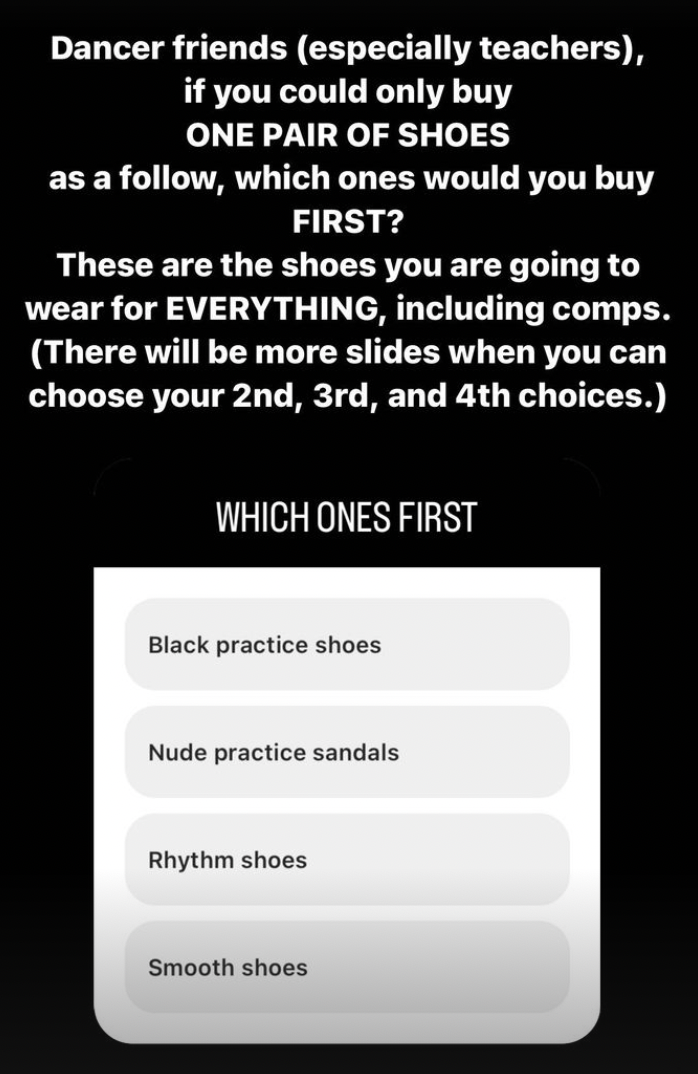
And then my brain exploded, as well as my DMs.
NOW, put on your seatbelts because it's going to be a bumpy ride.
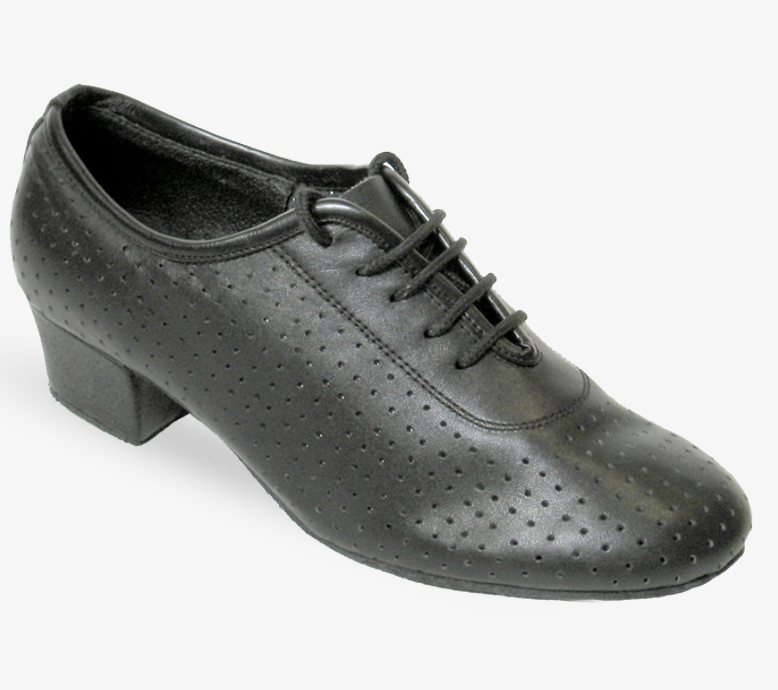
Black Practice Shoes
No, they should not be your FIRST PAIR OF SHOES if you have no funds with which to buy another pair of shoes before your first performance.
They make your legs look short, draw attention to your feet, and are not made to be pretty. AND WE'RE ALL MADE TO BE PRETTY, DAMMIT.
IF you wear them for a performance (a competition, or even a ballroom dance critiqued event), you should be wearing black leg coverings (fishnets, tights, or pants) to elongate your leg lines and look like a bad ass. If you have an injury which prevents you from wearing your "big girl shoes" (aka, a legit pair of Smooth or Rhythm shoes), then you must abide by these rules, as well.
YES, they are comfortable and cover your precious toes from marauding partners who might step upon your them, but STOP IT.
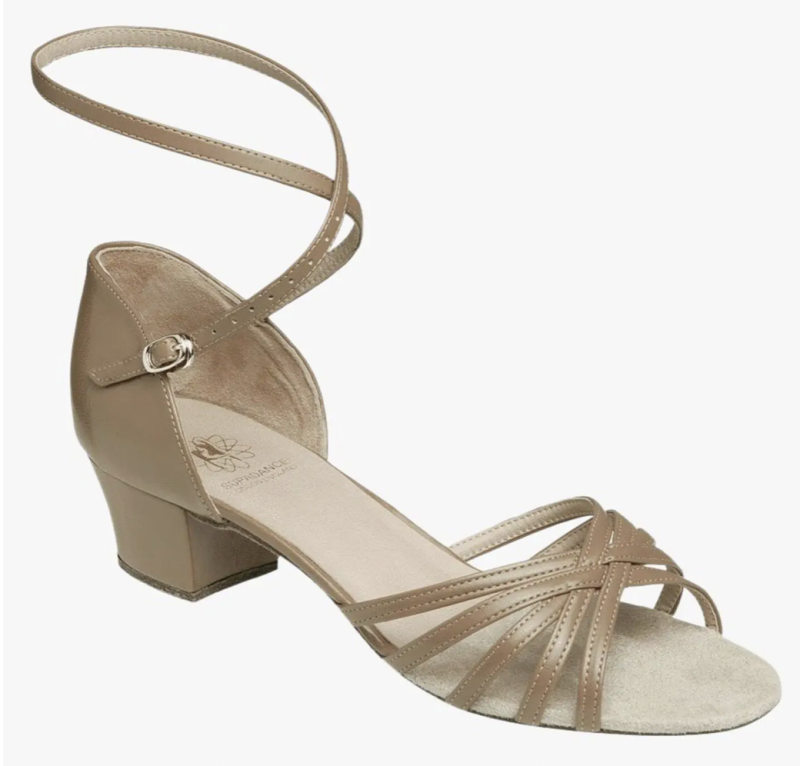
Nude Practice Sandals
YES, these should be your first pair of shoes.
They are versatile, have the same heel as the one above, and don't look stupid with not-pants.
You can buy any shade of nude needed, they are often made of leather (to stretch to fit your feet), and won't make you look like Bambi on ice.
[Back to the poll, people way cooler than me voted for nude practice shoes. So there.]

Rhythm Shoes
Please see the picture above.
HAHAHAHAHAHAHA.
But no, really. Wearing a pair of 3" heels while trying to figure how to stand up straight does not behoove anyone.
ESPECIALLY NOT WHEN YOU'RE DOING SMOOTH.
Rhythm/Latin shoes are made to pitch you towards the balls of your feet to maintain forward poise while the shorter shank gives LESS SUPPORT (which is great for Rhythm and Latin, where you're trying to articulate [point] your feet), but not great for Smooth when you need to rely on a sturdy heel to support your toe releases and heel leads.
They are not versatile, making Smooth/Standard footwork nearly impossible for newbies to oldies. And for many of us who enjoy our trainers, Crocs, and Uggs on the regular, hitting up a high heel right away is not a confidence-builder. Build up your dancing muscles (core, back, hips, knees, ankles, feet, oh hecking everything) with an easy low heel before going full-on Barbie.
NO, Rhythm shoes should not be your first pair of shoes.
AND LET ME TELL YOU, I bought a 3" pair of BLACK LATIN SANDALS for my first pair because no one told me not to and I hated Smooth for 10 years. COINCIDENCE? Probably, but I also snapped the heel off of one of those bad boys doing Foxtrot, so there you go.
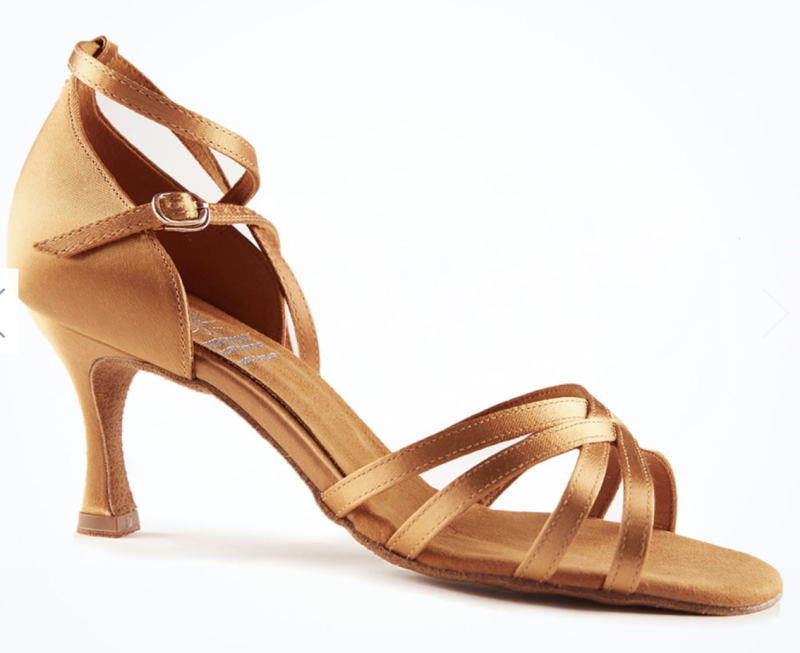
Smooth Shoes
WHAT HAS THE WORLD COME TO WHEN SMOOTH SHOES ARE MY SECOND CHOICE?
Smooth shoes are not "comfortable" or "pleasant" to wear. They are foot jails. BUT if you find the foot jails that fit you, they are tolerable.
They also have a lower heel that Rhythm shoes, with a longer shank (aka, more support) for your newly dancing feet and ankles, and DON'T INHIBIT GOOD FOOTWORK. Heel OR toe leads are completely manageable in these shoes. Toe releases? NOT IMPOSSIBLE. In fact, HIGHLY POSSIBLE. Easy, even.
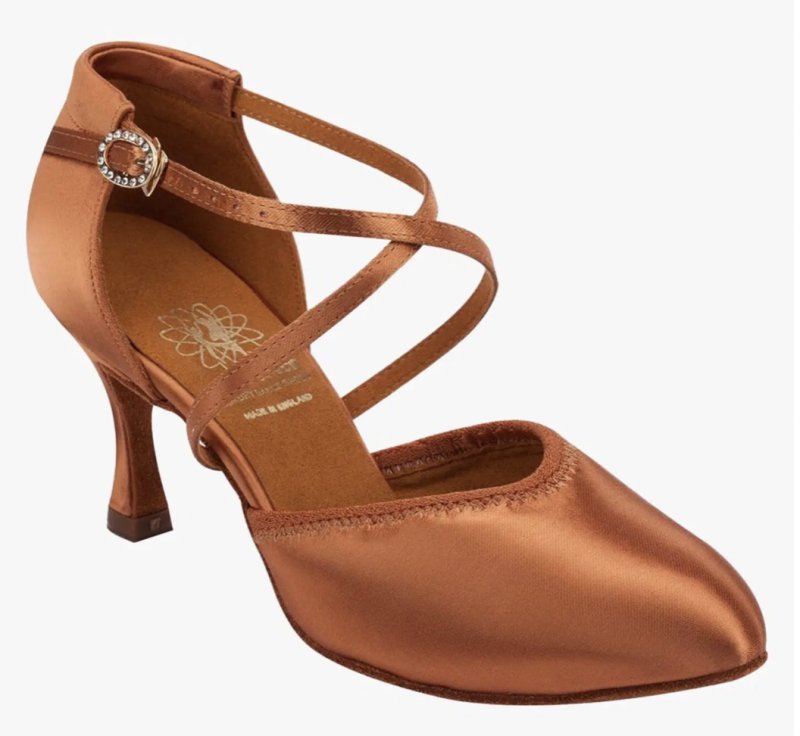
Do I keep showing your Supadance shoes? Yes, because I love them and Joanna Leunis. Always have, always will. I also love International. Bloch and Capezio and Very Fine do all right. There's a few other makers that are doing well, but I can't attest to them personally. Some brands fit different feet better (have generally smaller heel cups, wider vamps, thicker soles, etc.) so it's very helpful to try on a variety of shoes from a variety of makers, which is hard to do since many are overseas or just not local. So that sucks, but there's a fun challenge for you! Find your perfect shoe and live happy!
A Plea
Ye who work with college students or just new dancers in general, can we make movement to recommend a versatile and helpful shoe to our students? Just like we don't recommend Latin heels to new guys, let's get all our dancers in a great beginner shoe, so they can all turn up like this at the end of the movie.

Go forth and conquer.

-

First of all, there’s no “I” in “group class”, but there is in “private lesson”.
Did I write this whole post just to use that line?
Yes.
BUT SERIOUSLY…
It is a group. You are part of a group. You are one of 3-100 other unique individuals who are comprising a party of participants.
You are in a class. You are in a class with preplanned material for a particular level of dancer. The class is an organized educational experience with a teacher who has been hired for their skills and knowledge in communicating a certain thing.
You are there to soak up the instruction, encourage your fellow classmates (by smiling, nodding, and deferring questions to the teacher), follow the directions given, and internalize the patterns and techniques being introduced (or reviewed) by DOING THEM.
Group classes are for skill building. Have you learned about heel leads before? Maybe. Are you doing them 100% percent (yes, I meant what I typed) of all the time always when you are supposed to be? I will answer for you: NO. Do you practice heel leads? Maybe. Could you practice them while taking [what one hopes to be] a fun, sociable event geared towards other people like you, or people who would like to do what you do? I’ll answer again: YES. Heck, you could even practice your current technique of choice in a class without disturbing the other unique individuals in class!
Here’s some things to keep in mind while attending a group class:
- DO NOT GIVE FEEDBACK TO YOUR CLASSMATES. DO NOT. No, I know you’re going to say, “What about…” STOP IT. Whatever you’re going to say doesn’t matter. Do not “teach” while during class.
- Arrive on time and stay for the whole class.
- Stay off your phone.
- Switch partners. Unless you’re in a community education class, most studios and teachers have participants rotate partners. I PROMISE YOU IT IS WORTH IT.
- Let the teacher teach. This person has a plan, a method, and might have written more blog posts than the number of group classes you have attended [OR A SIMILAR AMOUNT OF EXPERIENCE]. Come along for the ride. It’ll be fun. (And if you hate it, try a different teacher.)
If you have a very particular question, I urge you to re-read the first sentence.
See you in class!

-
What is "dancing out of category"? Should I avoid it? Run head first into it? OR SHOULD I CONSULT A PROFESSIONAL?
This is based on a blog post from March 13, 2020 called "Dancing Out of Category".
My favorite podcast is The Thrilling Adventure Hour.
The ISTD is the unfortunately-acronymed, blue-ribbon standard (STATE FAIR JOKES! DANCE JOKES! ALL IN ONE PHRASE!) for the International styles.
The link that was supposed to be in my original post: https://riotandfrolic.typepad.com/blog/2015/12/dancing-downer.html
-
This is what is called "click bait" in the internet age.
Aimed mainly at my dearest dear darling collegiate students and suspiciously self-sufficient amateurs, this one's for you.
Things you can learn the week of a competition
What times do I dance?
What does the floor look like in the ballroom?
Who is judging?
What particular outfit from my competition gear am I choosing?
When am I doing my hair and makeup?
Who is doing my hair and makeup?
Who is videoing my dances?
What restaurants and coffee shops are nearby?
What time does the closest bar close?
Where is the restroom closest to the ballroom?
Where’s the practice room?
Where’s the changing room?
Where should I park?
Notice that none of those things started with “HOW”.
I love you, but stop taking lessons the week before your event. Well, stop taking your only private lessons of the year the week before you compete.
You know when you’re dancing in an event months, or at least weeks, in advance. TAKE YOUR PRIVATE LESSONS THEN.
The week before you dance an event, if you haven’t been taking private lessons previously or consistently, you know what I’m going to do? I’m going to tell you some nice performance tips like: stand up straight, look up, smile, etc. While that CAN be helpful, you’re not really learning anything, just being reminded of things you already know to do. Which again, CAN be helpful.
BUT.
Are you going to learn any terrific technique that you can apply in less than six days? Are you going to learn any new figures that you are going to make look nice, well-rehearsed (aka, like you know what you’re doing), and correct in less than six days?
NO.
I’m sure you’re thinking, “But I will practice them and I’m really quick at picking up new what’s-its and this will totally be worth my time and money”.
IT WILL NOT BE.
It takes about 300 repetitions of something to make it “learned”. Yes, yes, you might know what you’re supposed to do, but knowing and doing are two very different things, my friends. And if you can crack on with 300 repetitions of each new thing you’re told within a week of your performance event, you are a better person THAN EVERYONE ON THE PLANET.
Teachers will often ask what kind of information you’re looking for, if you’re taking a lesson with them for the first time: something along the lines of “this weekend” information, “next month” information, or “one year” info. Roughly, they’re wondering what can they tell you that you can apply immediately (smile when you are in left side position; say “purple hippopotamus” when you bow), what can they tell you that takes a bit of practice but won’t explode your brains (follows do two toe releases on feather finishes; here’s a simple Silver routine), or what is some great information for you to practice for the rest of your dance life (LATIN MOTION or Standard Foxtrot “basics”).
And private lessons are the BOMB when you’ve been taking group classes as your primary form of instruction. The generalized form of instruction provided in groups is GREAT for learning patterns and broad rules of movement, but are not specific to you, your physiology, your partnership, and your talents. So, stop taking private lessons right before an event and start improving your dancing… sooner. Like now. GO NOW.

-
-
I have taught many group classes. I've underestimated it to be around 3,000 group classes. Beginners to advanced, 3 to nearly 300 people, teacher training, formations, weird gigs at corporate events, high schoolers, collegiate… you name it.
And like a sailor at sea, there's calm days that go according to plan, and there's disasters that you train for, and then. There's the perfect storm. The class that you knew existed and had heard of in legends, but never experienced yourself.
Until now.*
*Yes, all of this really happened. No, you weren't in it. It happened years ago and I've had notes on it forever.
I was teaching a beginning level class that had a modest turnout most weeks. Most participants were taking private lessons, so the group class was mostly focused on reinforcing the basics.
This week, I had noticed a few unfamiliar couples hanging around in the lobby before class, so I was expecting some absolute beginners.
Possibly to my detriment, I feel very comfortable teaching beginners because I've taught so many over the years. I teach at a local university's ballroom dance club and have experimented on them for 10 years to see what methods get the majority of attendees moving and grooving in the least amount of time.
[YES, THE GIG IS UP. I'VE USED YOU FOR RESEARCH. SORRY, LOVVE YOU, UMNBDC! KATE, OUT!]
Getting large groups of people DANCING and figuring out what "takes" is fascinating! I've honed and edited and perfected and had good results. In other words, my confidence going into class was unshaken by the circumstances.
Back to class, my regulars show up, along with a few new couples. I start class.
It's Swing, btw. Just single time swing. [NO, THAT'S NOT LINDY.]
I literally have always started classes by walking. Forward, back, side steps. Boom. Done. EASY. Sighs of relief all around.
My general formula for class is:
- walking
- foot placement (side, side, back, forward) – everyone is dancing with themselves
- timing (slow slow quick quick, but with synonyms! one two, one two, one one; one two, three four, five six; sl-ow, sl-ow, quick quick; side, side, rock step; boop-shoopy, dop-shoppy, bip bop; etc.) – still dancing with themselves
- demonstration of the subject at hand
- quick tips for great success
- partner up! giddy up!
- dance a lot with music and switching of partners
- troubleshoot, then dance some more
- do a move by starting the whole process over (skipping the walking bit)
We begin doing the basic.
Six people walk in.
Not one or two, which I'm used to.
SIX.
Cool cool. The ocean is getting a little rough, but nothing I haven't seen before.
More basics, but let's count out loud together!
We partner up.
There's more guys than girls, but that's no problem. I tell the leads to do their part as if a partner was in front of them.
OH, that guy in the corner is NOT getting it. Like, NO. NOT DOING IT.
And this guy, right here, dancing with me, THINKS he's got it, but like, NO.
And his wife leans over, from where she's dancing with someone else, to tell me, that he doesn't got it.
WE'RE TAKING ON WATER, SAILORS.
"GENTLEMEN ON YOUR SIDE! LADIES ON YOUR SIDE!" I yell to bail out water.
Let's go back. The basic needs some work.
But no one wants to feel like they're being remedial. Or remediated? The seas are taller than my boat, but I am undeterred.
So I disguise more basics as "adding rotation". But MAYBE YOU DON'T HAVE TO ROTATE IF YOU'RE WORKING ON MOVING YOUR FEET IN GENERAL.
We count together.
We stomp our feet in rhythm, to make sure we're doing weight transfers.
We partner up.
I'm playing fun music REALLY LOUD and counting people in TOO QUICKLY after switching partners, so a different lady doesn't have enough time or volume to teach each one of her new partners. I am sailing into the eye of the storm.
Everyone I dance with is smiling and having a great time, but holy crap, it's still a mess out there.
One guy cannot hear the music. Or my very loud voice counting, which seems impossible. I tell the guys to copy off their neighbors, or at least pick a rhythm and stick to it. I have made it through the eye, but now am into the other side of the storm. I AM NOT AFRAID.
That first guy is not going to get it. I've made peace with that. I'll tell everyone how to cheat and still make their partner happy.
I did three other exercises I'd never done before to get across the point of the basic (aka: move your feet).
Guys.
We are 25 minutes into class and still doing the basic.
I decide to move on, because sometimes the next challenge solidifies the previous one as "easier".
We do the underarm turns. Literally 8 times for the ladies. And another 8 times for the men.
I don't know if you're recalling the lead's part for underarm turns in Swing, but it's the basic… while lifting one arm.
Yes, I made them do MORE basics.
We made it to shore. It was glorious. The fact that I tricked them into more basics, not the actual basics themselves. Those were still mediocre.
At the end of the 50 minute class, everyone was doing… something to music. It might not have been exactly Swing, but they were having fun and didn't want to stop when the music did. And while I'm a sucker for righteousness in the ballroom, I'm also a fan of having a good time.
-
I've noticed a phenomenon in syllabus levels of ballroom dance competitions where a couple (or a student, in a pro-am situation) will make several cuts in competitive events and as they get closer to the final, their dancing changes.
Their dancing becomes MOAR.
MOAR ARMS.
MOAR SMILES.
MOAR HIPS.
MOAR BIG.
MOAR DANCING.
And this is generally unfortunate, because the dancing that they had done up to this point was the dancing that made them make those substantial first cuts.
The thing is, in the lower syllabus levels, you don't know how to do better dancing. You don't know where to put the more into your dancing to make it even worthier of marks, awards, and finals.
So, you end up putting energy into your arms (and they get disconnected from your movement), or you put more pep in your step (and you get off time with the music, or you bump into your unsuspecting partner), or you emote so much you frighten the otherwise unflappable judges.
Doing more is not what you think it is.
In other words, you start dancing worse.
Your dancing is lovely. It's what got you into the quarterfinal, semifinal, and final. Stopping doing something different! (Smiling moar is always a good choice, though.)



 Riot and Frolic